What Is an AAC Evaluation and What Does It Include?

If your child has been referred for an AAC evaluation, you might be wondering: What exactly does that mean? What will happen during the appointment? And what comes after?
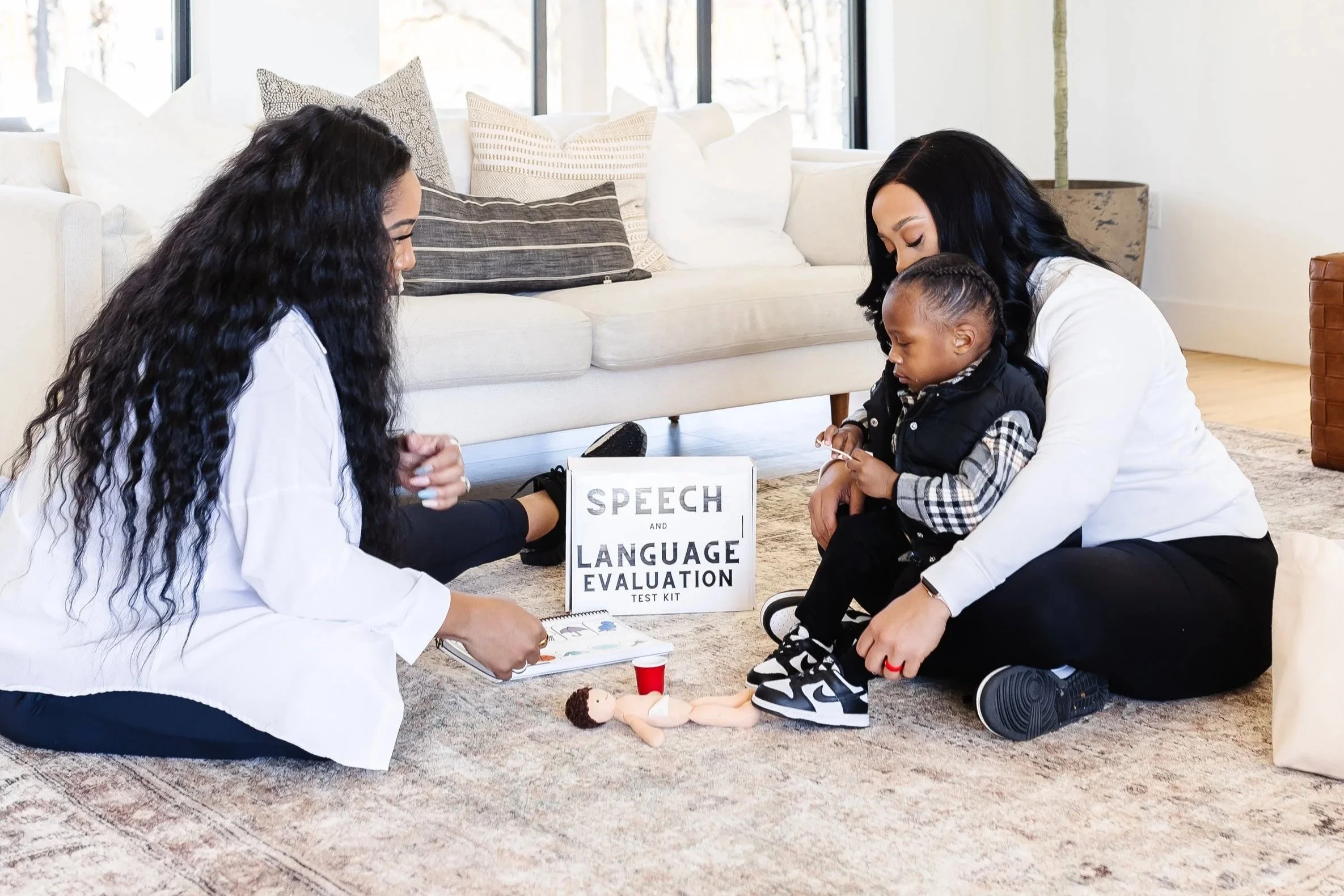
An AAC evaluation (also called an AAC assessment) is a specialized type of speech-language evaluation focused on finding the best communication tools and strategies for your child.
It's a positive, collaborative process, not a test your child can pass or fail.
This guide explains everything parents need to know about what an AAC evaluation is, what it includes, who conducts it, and how to prepare.
FREE! Grab our free child speech therapy guide!
What is an AAC evaluation?
An AAC evaluation is a comprehensive assessment conducted by a speech-language pathologist (SLP) to determine whether Augmentative and Alternative Communication (AAC) would benefit a person and if so, which type of AAC system best matches their communication needs, abilities, and goals.
Not sure what AAC stands for? Find out exactly what AAC is here!
Who Conducts an AAC Evaluation?

An AAC evaluation is always led by a licensed speech-language pathologist(SLP). Depending on your child's needs, the evaluation may also involve:
An occupational therapist (OT) to assess motor skills, hand function, and device access
A physical therapist (PT) if positioning or mobility affects how your child interacts with a device
An assistive technology specialist for complex high-tech device recommendations
A special education teacher or school psychologist particularly for school-based evaluations
You, the parent or caregiver, your knowledge of your child is essential input
Some evaluations are conducted through private speech therapy clinics, while others are arranged through the school district (if your child has an IEP) or through a children's hospital or AAC center.
We provide AAC evaluations! Schedule a discovery call here to discuss!
What Happens During an AAC Evaluation?
An AAC assessment typically covers several key areas. Here is what you can expect:
1. Background Interview and Case History
The SLP will start by gathering information about your child's communication history, medical background, current abilities, daily routines, and environment. Expect questions like: How does your child communicate now? What are their biggest communication frustrations? What settings do they need to communicate in?
2. Communication Skills Assessment
The SLP observes and evaluates how your child currently communicates, through speech, gesture, vocalization or other means. They assess both receptive language (understanding) and expressive language (expressing), as well as how your child communicates across different situations.
3. Motor and Access Assessment
This step looks at how your child can physically interact with AAC tools. The evaluator assesses fine motor skills, hand-eye coordination, vision, and whether your child can use direct touch, eye gaze, switch access, or another access method to operate a device.
4. Cognitive and Literacy Assessment
The SLP considers your child's cognitive level and any literacy skills. This helps determine whether symbol-based AAC, text-based AAC, or a combination is the right fit and how complex the vocabulary and layout of a system should be.
5. AAC Trials
One of the most important parts of the evaluation: your child actually tries different AAC options. The SLP may introduce picture boards, communication apps, or speech-generating devices and observe how your child interacts with each. This hands-on trialing is crucial to finding the right fit.
6. Feature Matching
Based on all the information gathered, the SLP matches your child's profile to specific AAC features, vocabulary size, layout, visual supports, access method, portability, voice output, and more. The goal is a system that fits your child's life, not just their clinical profile.
How long does an AAC evaluation take?
Most AAC evaluations take between 1 and 3 hours, though complex cases may require multiple sessions. Some evaluations include a trial period of several weeks during which the child uses a recommended device before a final recommendation is made.
Related: We offer pediatric speech therapy in Springfield IL and surrounding areas. If you think your child needs speech therapy, contact us today!
What Does an AAC Assessment Report Include?

After the evaluation, the SLP writes a formal report. This document is important, it is the foundation for treatment planning, school programming, and insurance funding.
A thorough AAC assessment report typically includes:
Background history - medical diagnosis, prior therapy, communication history
Current communication profile - how the child communicates today and what is and isn't working
Assessment findings - results from standardized and informal assessments across all areas evaluated
AAC recommendation - specific system(s) recommended, including device name, app, or symbol set
Access method - how the child will interact with the AAC system (touch, eye gaze, switch, etc.)
Vocabulary recommendations - what words and symbols should be included at the start
Implementation plan - goals, therapy frequency, and guidance for home and school use
Funding justification - documentation to support insurance or school district funding requests
Related: What is reading intervention?
School-Based vs. Private AAC Evaluations: What's the Difference?
You might be surprised to learn that there are two distinct pathways for an AAC evaluation, and they are not the same.
1.School-Based AAC Evaluation
Conducted by school district SLP
Focuses on educational needs in school
Free under IDEA (if educationally necessary)
Device may be school-owned (not sent home)
Tied to IEP goals and school placement
2. Private AAC Evaluation
Conducted by private or clinical SLP
Addresses full communication needs across all settings
May be covered by insurance or Medicaid
Device recommended for home and community use
Independent of school; broader scope
Many families pursue both: a school-based evaluation to address educational needs and a private evaluation to ensure their child has access to AAC in all areas of their life. Your child's SLP can advise which pathway, or combination, makes sense for your situation.
Related: How to get an IEP for speech therapy
How to Prepare for Your Child's AAC Evaluation
Here's what to bring and think about beforehand:
Gather records: any prior speech-language evaluations, IEP documents, medical diagnoses, or therapy notes
Make a list of how your child communicates now: words they use, gestures, sounds, behaviors, anything that functions as communication
Note communication challenges: where does your child get most frustrated? What can't they express?
Think about environments: home, school, community, therapy, where does your child need to communicate most?
Bring your child's interests: favorite toys, characters, or activities can help the SLP engage your child and set vocabulary priorities
Write down your questions: this is your time to ask about funding, timelines, device options, and next steps
What should I expect after an AAC evaluation?
After the evaluation, the SLP will share their findings and recommendation, typically in a written report. Next steps may include trialing a device, ordering or funding a device, beginning AAC-focused speech therapy, and training you and your family on how to use and support the system at home.
How Is an AAC Evaluation Different from a Regular Speech Evaluation?
A standard speech-language evaluation assesses a wide range of communication skills, articulation, language, fluency, voice, and more. An AAC evaluation is more specialized: it focuses specifically on determining the best communication tools and supports for someone who needs alternative or augmentative means to communicate.
An AAC assessment also has a practical, device-oriented dimension that a general speech evaluation does not. The SLP is not just documenting what a child can and can't do, they're actively trialing tools and matching features to the child's unique profile.
Some children are referred for an AAC evaluation after a general speech evaluation has identified significant communication challenges. Others are referred directly based on a diagnosis or recommendation from a physician, developmental pediatrician, or neurologist.
Have specific questions? Schedule a free discovery call here!
Frequently Asked Questions About AAC Evaluations
What is an AAC evaluation?
An AAC evaluation is a specialized speech-language assessment that determines whether AAC (Augmentative and Alternative Communication) is appropriate for a person, and identifies which type of AAC system best fits their communication needs, physical abilities, and life circumstances.
What happens in an AAC evaluation?
The evaluation includes a parent/caregiver interview, observation of current communication skills, motor and access assessment, cognitive and literacy screening, hands-on AAC trials, and feature matching. The SLP then writes a report with findings and a specific AAC recommendation.
Who performs an AAC assessment?
A licensed speech-language pathologist (SLP) leads the assessment. Depending on the child's needs, an occupational therapist, physical therapist, or assistive technology specialist may also be involved.
Is an AAC evaluation covered by insurance?
In many cases, yes. Private insurance, Medicaid, and school districts under IDEA may cover AAC evaluations. Coverage depends on your plan and your child's diagnosis. Your SLP or the evaluating clinic can help you understand your options and assist with prior authorization paperwork.
How do I request an AAC evaluation for my child?
You can request an AAC evaluation through your child's pediatrician or developmental specialist, your child's school district (if they have an IEP or qualify for special education), or directly through a private speech therapy clinic or AAC center. You do not need a physician referral in all states, but it can help with insurance
What is the difference between an AAC evaluation and an AAC assessment?
The terms AAC evaluation and AAC assessment are used interchangeably. Both refer to the same comprehensive process conducted by an SLP to determine AAC eligibility and recommend the most appropriate AAC system.
What age can a child have an AAC evaluation?
There is no minimum age. AAC evaluations can be conducted for children who show significant communication delays or have a diagnosis associated with communication challenges. Early evaluation is strongly encouraged when concerns are present.
Remember: An AAC Evaluation Is a Pathway to Communication

An AAC evaluation is one of the most empowering steps you can take for a child who is struggling to communicate. It's not about confirming limitations, it's about discovering what's possible.
The right AAC system, matched well to your child's profile, can open up communication in ways that transform daily life, at home, at school, and in the community. The evaluation is where that journey begins.
If you've been told your child might benefit from AAC, or if you're concerned about their communication development, don't hesitate to ask for an evaluation. The sooner the process starts, the sooner your child has the tools they need to communicate.
Ready to schedule an AAC evaluation?
Book a free consultation and let’s chat about what’s best for you and your family!